Are Silicone Molds Safe for Baking? The Short Answer
Yes \u2014 food-grade silicone molds are safe for baking when they carry recognized certifications such as FDA 21 CFR 177.2600 (US) or LFGB \u00a730 & \u00a731 (EU/Germany). These standards confirm that the silicone will not leach harmful chemicals into food at temperatures up to 230 \u00b0C (446 \u00b0F). The key word is food-grade: not all silicone on the market meets these thresholds. For B2B buyers sourcing wholesale silicone bakeware, verifying certification documentation is the single most important step before placing a bulk order.
If you are a distributor, bakery chain, or private-label brand evaluating suppliers, this guide breaks down exactly what “safe” means in regulatory terms, what to look for in test reports, and how to avoid non-compliant products that could trigger recalls or customs rejections in European and North American markets.
What Makes Silicone “Food-Grade”?
Food-grade silicone is a platinum-cured or peroxide-cured polymer that has passed migration testing \u2014 meaning regulators have confirmed that no harmful substances transfer from the mold into food under normal use conditions. The base material (polydimethylsiloxane, or PDMS) is chemically inert, odorless, and non-toxic by nature. What separates food-grade from industrial-grade silicone is the curing process and the additives used.
Platinum-cured silicone is the gold standard for food contact. It produces no by-products during curing, resulting in a purer final product with zero risk of peroxide residue. Peroxide-cured silicone is less expensive but requires a thorough post-cure (secondary vulcanization at 200 \u00b0C for 4+ hours) to burn off residual peroxides. Both can achieve food-grade status, but platinum-cured silicone passes migration tests more consistently and is preferred by premium European brands.
For wholesale buyers, the practical takeaway: always ask your supplier which curing method they use and request the post-cure protocol documentation. A reputable silicone mold manufacturer will provide this without hesitation.
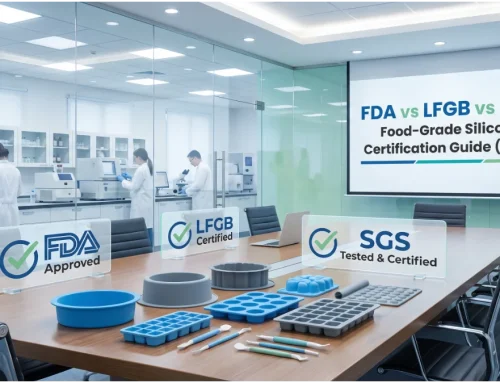
FDA vs LFGB vs SGS: Which Certification Do You Need?
Different markets require different compliance frameworks. Here is how the three most common certifications compare for silicone bakeware:
| Certification | Market | Standard | Key Test | Typical Cost to Supplier |
|---|---|---|---|---|
| FDA | United States | 21 CFR 177.2600 | Overall migration in food simulants (acetic acid, ethanol, heptane) | $800\u2013$1,500 |
| LFGB | Germany / EU | \u00a730 & \u00a731 (BfR XV) | Migration + organoleptic (taste/odor) + composition analysis | $1,500\u2013$3,000 |
| SGS / Intertek | Global (buyer-specific) | Varies by client spec | Custom panels: heavy metals, BPA, phthalates, PAHs | $500\u2013$2,000 |
For European buyers: LFGB is the most stringent and is widely accepted across the EU as proof of food-contact safety. If your supplier holds a current LFGB report from an accredited lab (T\u00dcV, SGS, Bureau Veritas), you are covered for EU market entry under Regulation (EC) 1935/2004.
For North American buyers: FDA compliance is mandatory. Note that FDA does not “certify” products \u2014 it sets the standard, and the supplier’s test report from an accredited lab demonstrates compliance. Ask for the full report, not just a certificate summary.
We cover the technical differences in depth in our food-grade silicone certification comparison guide, including how to read a test report and spot red flags.
Temperature Safety: What Silicone Can and Cannot Handle
Food-grade silicone is rated for continuous use from \u221240 \u00b0C to +230 \u00b0C (\u221240 \u00b0F to +446 \u00b0F). This range covers every standard baking application: oven baking (typically 160\u2013220 \u00b0C), microwave heating, freezer storage, and dishwasher cleaning. Within this range, certified silicone does not degrade, warp, or release chemicals.
Three scenarios where safety can be compromised:
Exceeding 230 \u00b0C. At temperatures above the rated limit \u2014 for example, under a broiler/grill element or directly on a stovetop \u2014 silicone can begin to break down. This is not a normal baking scenario, but it is worth communicating to end consumers on packaging.
Non-certified fillers. Some low-cost molds use silicone blended with calcium carbonate or other fillers to reduce material cost. These fillers can create micro-pores that harbor bacteria and may fail migration tests. The “pinch test” (pinch the silicone and look for white streaks) is a quick field indicator of fillers, though it is not a substitute for lab testing.
Degraded molds. Even certified silicone has a functional lifespan. Commercial bakeries running 8+ hours daily should inspect molds every 6\u201312 months for surface cracking, discoloration, or loss of non-stick properties. Our commercial-grade silicone guide covers expected lifespan by usage intensity.
Is Silicone Mold Safe for Baking? What the Research Says
Multiple peer-reviewed studies and regulatory assessments confirm the safety of food-contact silicone:
The European Food Safety Authority (EFSA) evaluated siloxanes and concluded that high-molecular-weight PDMS (the type used in bakeware) poses no health risk at migration levels far exceeding those measured in actual use. The German Federal Institute for Risk Assessment (BfR) reached the same conclusion in its Recommendation XV on silicones for food contact.
In practical terms: a 2019 study published in Food Additives & Contaminants tested 20 silicone bakeware products under worst-case conditions (200 \u00b0C, 4 hours, fatty food simulant). Overall migration averaged 2.1 mg/dm\u00b2 \u2014 well below the 10 mg/dm\u00b2 regulatory limit. Products that had been properly post-cured showed migration below 0.5 mg/dm\u00b2.
The bottom line for B2B buyers: certified, properly manufactured silicone bakeware is among the safest food-contact materials available. The risk lies not in the material itself but in sourcing from suppliers who skip post-cure steps or use non-compliant raw materials.
How to Verify Supplier Safety Claims (B2B Checklist)
Before committing to a wholesale order, run through this verification checklist:
1. Request full test reports, not just certificates. A certificate is a one-page summary. The report contains methodology, conditions, and raw data. Insist on reports from ISO 17025-accredited laboratories.
2. Check report dates. Migration test reports are typically valid for 1\u20132 years. A report from 2019 does not cover a formulation change made in 2024. Ask for the most recent batch-specific report.
3. Confirm the tested product matches what you are buying. Reports are product-specific. A test on a silicone spatula does not cover a silicone cake mold. Verify the report references the exact SKU or product family.
4. Ask about raw material sourcing. Premium suppliers use branded base polymers (Dow Corning/Silopren, Wacker, Shin-Etsu). Ask which grade they use and whether they can provide a material safety data sheet (MSDS).
5. Request a sample for independent testing. For orders above $10,000, it is standard practice to send a sample to your own lab (SGS, Intertek, T\u00dcV) for confirmation testing. Budget $300\u2013$800 and 7\u201310 working days.
6. Verify BPA-free and phthalate-free status. While pure silicone contains neither, additives or release agents in the manufacturing process could introduce traces. Explicit BPA/phthalate testing adds confidence, especially for baby-product or health-food brands.
Common Myths About Silicone Bakeware Safety
“Silicone melts in the oven.” False. Food-grade silicone does not melt below 500 \u00b0C. It will char and degrade above 230 \u00b0C over extended periods, but it does not liquefy like plastic. Normal baking at 180\u2013220 \u00b0C is well within the safe zone.
“All silicone is the same.” False. Industrial-grade silicone (used for gaskets, sealants) may contain plasticizers, heavy-metal catalysts, or non-food-safe pigments. Only silicone explicitly manufactured and tested for food contact qualifies as food-grade.
“Silicone leaches chemicals when heated.” Misleading. Certified food-grade silicone shows negligible migration below 230 \u00b0C. The studies that detected higher migration typically tested non-post-cured or filler-loaded products \u2014 exactly the type a quality-conscious buyer avoids.
“You cannot trust Chinese-made silicone.” Unfounded as a blanket statement. China produces the majority of the world’s silicone bakeware, including for top European and American brands. The determining factor is not country of origin but whether the factory follows proper curing protocols and holds current third-party certifications. Many reputable manufacturers operate ISO 9001-certified facilities with in-house QC labs.
What to Look for on Product Labels and Packaging
When evaluating finished goods for retail or distribution, check for these markers:
The food-contact symbol (a wine glass and fork icon) is mandatory in the EU under Regulation 1935/2004. In the US, look for “FDA Compliant” or “Meets FDA 21 CFR 177.2600” language. Temperature range markings (e.g., “\u221240 \u00b0C to +230 \u00b0C”) indicate the manufacturer has tested to those limits. “Platinum-cured” or “Platinum silicone” labeling signals a higher-grade manufacturing process.
For private-label orders, work with your supplier to ensure all required markings appear on your branded packaging before shipment. Customs authorities in Germany, France, and the Netherlands actively inspect food-contact imports for correct labeling.
FAQ: Silicone Mold Safety Questions Buyers Ask
Are silicone molds safe for baking cakes and bread?
Yes. Certified food-grade silicone molds are safe for all standard baking applications including cakes, bread, muffins, and pastries at temperatures up to 230 \u00b0C. The material is inert and does not react with acidic ingredients (lemon, vinegar, tomato) or fatty batters.
Do silicone molds release toxic fumes when heated?
No. Within the rated temperature range (up to 230 \u00b0C), food-grade silicone does not emit fumes. If overheated beyond 300 \u00b0C, silicone may release silica dust (white ash), but this scenario does not occur in normal oven use. This is fundamentally different from PTFE (Teflon), which can release toxic fumes above 260 \u00b0C.
Is silicone safer than non-stick metal pans?
For chemical safety, yes. Silicone contains no PFOA, PTFE, or heavy-metal coatings that can chip or degrade over time. Non-stick metal pans rely on chemical coatings that wear with use. Silicone’s non-stick property is inherent to the material and does not diminish with proper care.
Share This Story, Choose Your Platform!
Related posts