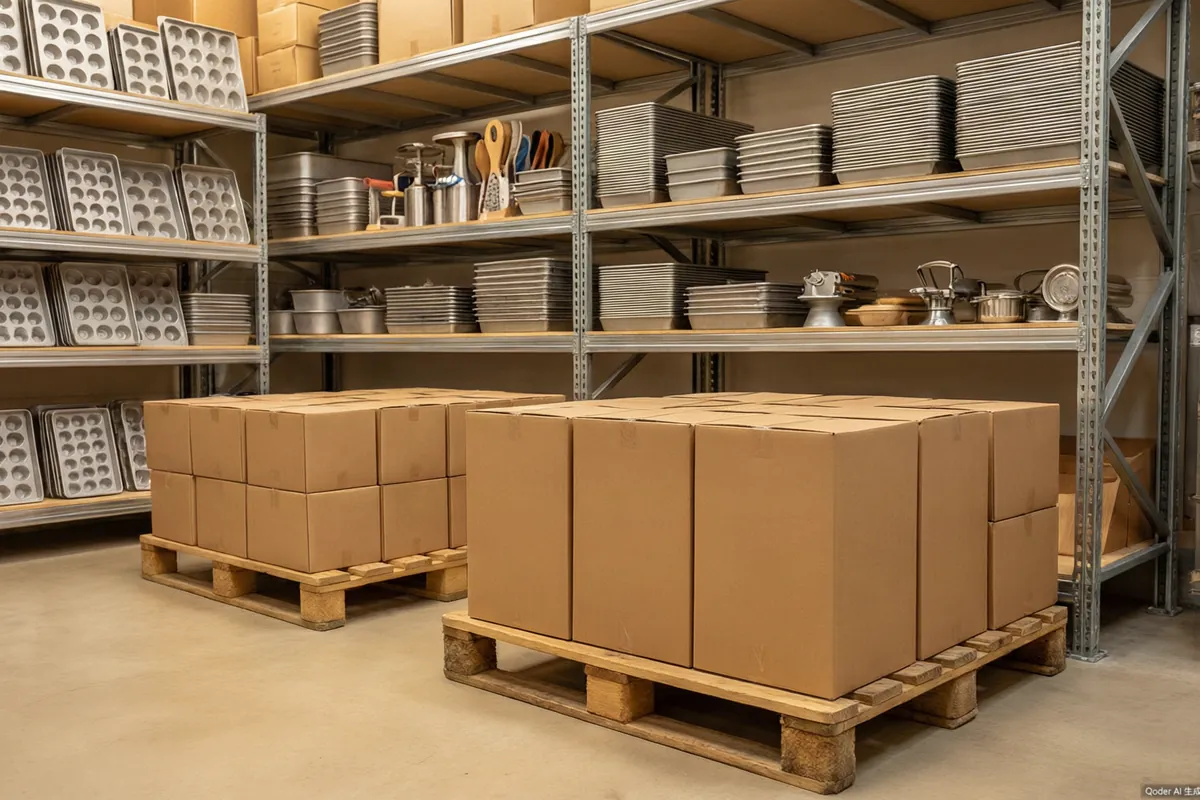
Wholesale bakery supply sourcing means buying baking equipment, molds, tools, and consumables directly from manufacturers or authorized distributors at volume pricing — typically 30–60% below retail — with MOQs starting around 100–500 units per SKU. For bakeries, distributors, and retail chains, a reliable wholesale bakery supply partner determines both product margins and shelf consistency across seasons.
This guide covers what to buy, how supplier pricing actually works, and the vetting criteria that separate dependable wholesale partners from risky ones. It reflects 15 years of export experience at XBAKING, a manufacturer supplying bakery supplies to North American and European distributors.
Why Bakeries and Distributors Buy Wholesale
Three commercial realities drive wholesale purchasing in the bakery channel:
Margin structure. Retail bakery supply pricing carries 2–3 intermediary markups. Buying at factory or first-tier distributor level typically secures 30–60% lower unit costs, which either lifts distributor margin or funds competitive retail pricing.
Consistency at scale. A bakery chain running 20 locations needs identical sheet pans, molds, and tools in every kitchen. Wholesale programs guarantee SKU continuity and color/spec matching across re-orders — retail shelf buying cannot.
Seasonal planning. Holiday baking demand spikes 2–4× between October and December. Wholesale contracts with pre-season stock commitments protect against stockouts when retail channels sell through first.
Core Categories in a Wholesale Bakery Supply Program
| Category | Best-Selling Items | Typical Wholesale MOQ | Replacement Cycle |
|---|---|---|---|
| Silicone bakeware | Cake molds, muffin trays, baking mats | 300–1,000 units/SKU | 2–5 years |
| Metal bakeware | Sheet pans, bundt pans, loaf tins | 500–2,000 units/SKU | 3–7 years |
| Decorating tools | Fondant molds, piping tips, turntables | 200–800 units/SKU | 1–3 years |
| Preparation tools | Rolling pins, scrapers, dough cutters | 300–1,500 units/SKU | 2–4 years |
| Proofing & storage | Banneton baskets, dough containers | 200–1,000 units/SKU | 1–3 years |
For most wholesale programs, silicone bakeware is the anchor category: highest margins, lightest shipping weight per unit value, and the strongest private-label differentiation. Our complete product line and margin analysis breaks down the commercial case by category.
How Wholesale Pricing and MOQs Actually Work
Wholesale bakery supply pricing follows volume tiers rather than fixed lists. The structure most factories and distributors use:
- Trial tier (100–500 units): base wholesale price, usually 30–40% off retail equivalent.
- Standard tier (500–3,000 units): another 10–20% discount; this is where most distributors operate.
- Container tier (mixed full container): deepest pricing, 50–60% below retail, with freight optimization per unit.
Two negotiation points matter more than the headline price. First, re-order price protection — lock pricing for 12 months so seasonal planning is not exposed to raw material swings. Second, defect policy — written commitment to replace or credit defective units above an agreed threshold (industry standard: claims honored above 1–2% defect rate).
Choosing a Wholesale Bakery Supply Partner: 5 Vetting Criteria
1. Export track record. Ask for years of export experience and destination markets. A supplier shipping to the US and EU continuously for 10+ years has already solved compliance, packaging, and logistics problems you would otherwise debug yourself.
2. Certification coverage. Food-contact items require FDA (US) and LFGB / EU 10/2011 (Europe) test reports per product category. Verify reports are current — within 24 months — and match the SKUs you are buying. Our documentation set is listed in the certifications overview.
3. MOQ flexibility. Early-stage distributors need 100–300 unit MOQs with mixed-SKU containers; factories that only quote 5,000+ minimums are built for retail chains, not growing distributors.
4. Quality systems. Request the supplier’s QC protocol: incoming material checks, in-line inspection, and pre-shipment AQL sampling. Documented processes are covered in our factory QC overview.
5. Customization depth. Even stock-driven programs eventually need private label: custom colors, logos, and packaging. Confirm custom capability exists before you need it — our private label guide covers what a complete program includes.
Ordering Logistics: From First Inquiry to Delivery
A first wholesale order typically runs this timeline: inquiry and catalog review (1–3 days) → sample order and evaluation (2–3 weeks) → commercial terms and proforma invoice (1 week) → production (25–40 days) → ocean freight to US/EU (30–45 days). Total: roughly 10–14 weeks from first contact to goods on your dock.
Plan seasonal inventory against this timeline with a 4-week buffer. For December holiday sales, final orders should be confirmed by early August; for Easter and spring baking, by late November.
Before your first large order, run the supplier evaluation checklist in our companion guide: 10 points to check when purchasing custom silicone bakeware from Chinese suppliers.
FAQ: Wholesale Bakery Supply
What is the minimum order for wholesale bakery supplies?
Most manufacturer-direct programs start at 100–500 units per SKU, with mixed-SKU containers accepted for trial orders. Pricing improves in tiers at 500, 3,000, and full-container volumes.
How much cheaper is wholesale bakery supply than retail buying?
30–60% below equivalent retail pricing depending on volume tier and category. Silicone bakeware and decorating tools sit at the higher end of the discount range; commodity metal pans at the lower end.
Can I private label wholesale bakery supplies?
Yes. Custom Pantone colors, debossed or printed logos, and retail-ready packaging are standard offerings from manufacturer-direct suppliers, typically requiring 500–1,000 units per SKU and a one-time setup for packaging artwork.
What certifications should wholesale bakery supplies have?
FDA 21 CFR 177.2600 for US food-contact sales, LFGB or EU 10/2011 for Europe, and BSCI/SEDEX audit reports if you supply retail chains. Always verify reports are current and SKU-specific.
How do I handle defective wholesale goods?
Agree a written defect policy before ordering: suppliers typically replace or credit units above a 1–2% defect threshold, verified by photos or third-party inspection (SGS/Intertek). Inspect within 30 days of arrival, since most claim windows close after that.
Share This Story, Choose Your Platform!
Related posts